Nancy

Documentation. Witnesses. Facts. Truth. That's what they're afraid of.
Showing posts with label #Economy. Show all posts

Friday, January 20, 2017

The Daily Combover - January 20, 2017 - Inaugural Atrocities Edition

Think of the one thing that, in your opinion, the government does best. Now brace yourself because there is a good chance that the government won't be doing it any more by Monday if not already today.

You might not know it if you've been watching CNN coverage gushing over the Trumps and comparing them to the Kennedys, but the minute Trump took his hand off the Bible, a series of destructive actions were set in place that would make any Bond or Batman villain jealous. "The Trumpster" has been unleashed.

When we learned that Trump had only made 4% of his appointments most probably assumed that was out of laziness or incompetence. But what if it was to avoid dissenting opinions? Trump has proven himself to be every bit the authoritarian Mussolini was at his gatherings. And now he's putting it into practice.

Some call it corporatism, others oligarchs, and others simply call it libertarianism. Regardless of your preferred nomenclature, the outcome is the same: extract as much value as you can out of the resources at hand (land, labor, and capital) and maximize short run profits with no regard for future implications. To you, the worker, that means you are going to be expected to put forth maximum effort at the lowest possible pay they can get away with giving to you.

In case you're in the 32% of the country made up of leftwing ideologues and Trump voters that are happy about Trump right now, it's important that, as you read this list, you realize both sides are far from the same thing. His policies will directly and indirectly lead to the death of millions by increasing poverty and uninsured levels.

With no further ado, here are today's atrocities:
1. An executive order "easing of the burden" of the Affordable Care Act. Read this as going as far he he possibly could under the law to empower the Republicans to prevent people from receiving health care coverage.

2. His Chief-of-Staff, Reince Priebus, issued a memo halting the passage of any new regulations at the Federal level.  All signs point to this being the first stage of a rollback of federal regulation across the board.

3. An executive order eliminating the fee discount under the FHA that most middle class households took advantage of when buying a home.  This will have a huge drag on home sales. Existing home sales (which are the primary units affected by this) currently make up about a $900 billion annual impact on GDP. That's roughly 5% of our GDP.  If sales slow down by 20%, that's a 1% reduction in GDP.  Historically a reduction in home sales is often always followed by a recession.

Give a hug to someone who needs it and then get on the phone with your Senator urging them to stand up against this administration's egregious overreach. Catch you on the flip side. 

Wednesday, January 4, 2017

The Federal Minimum Wage is on the Chopping Block

Back in 2013, the Obama White House put out a fact sheet detailing the impact of raising the minimum wage to $9. Eventually the President realized the GOP didn't want to play ball so he did the only thing he could do and raised it for Federal contractors  (to $10.20/hour).

At the time there was some contention about minimum wages lowering employment and at the same time not affecting any significant number of workers.

But as the linked fact sheet shows, most research has found no significant negative impact of minimum wage hikes on employment thanks to the monopsonization of our workforce.  Furthermore, raising the minimum wage from $7.25 to $9 for 5 million people has a direct impact on the wages of 10 million other people as well (those between $7.25 and $9). There may also be an indirect spillover as minimum wage workers increase consumption and therefore wages in other sectors also rise but that typically takes a bit of time to unfold. This is what the White House referred to as the "ripple effect."

Jump ahead 4 years to today and the opposite proposal is coming from our incoming government. They want to axe the minimum wage entirely. They cite statistics from the BLS showing that the number of minimum wage workers has fallen below 3 million people and they claim the states can deal with that <1% of the population. What they ignore are the 20.6 million people who are near-minimum wage. While under 3 million people are earning $7.25 or less, 10 million people earn between $7.25 and $9, and another 8 million people earn between $9 and $10.10 per hour.

So who would be affected by the reverse?: While 29 States plus DC have minimum wages above the Federal minimum and therefore wouldn't be affected by this, 21 states are at or even below the Federal minimum. So those 3 million or so workers are mostly clustered in those 21 states.  And just as others would find their wages rising when the minimum wage increases, so would we see the wages of others falling when the minimum wage decreases. As a result, at least 10 million people would immediately be looking at a smaller paycheck once the repeal is enacted. Who would be worst off?

Idaho, Iowa, Kentucky, New Hampshire, North Carolina, North Dakota, Pennsylvania, and Wisconsin all have State Minimum Wages at the Federal level of $7.25. So workers in those eight States will not be directly impacted.

And Indiana and Kansas use the Federal Minimum but have a sub-minimum wage of $4.25 for teenagers. That brings us up to 10 of the 21 that will not be directly impacted.

Major impacts on wages will be felt on the following States:
Georgia and Wyoming have a State Minimum Wage of $5.15. And Alabama, Louisiana, Mississippi, Oklahoma, South Carolina, Tennessee, Texas, Utah, and Virginia all use the Federal Minimum Wage but do not have a State Minimum Wage -- which means they basically view $7.25 as a ceiling and not a floor.

And using BLS statistics,  what we can see is that 20% of the workers in those 11 states will see their wage fall. The only one of those 11 states that has a Democratic governor who wields enough power to prevent a collapse of the wage structure is Virginia. Workers in the other 10 are in big trouble. 

Wednesday, December 28, 2016

Cutting Taxes without a Tax Cut

As Jason pointed out recently, eliminating Obamacare would provide a huge tax cut to the top 0.1% -- about $154,000 on average. Republicans also have plans to cut taxes beyond that through a massive cut to the corporate rate, but even that won't be enough for their big money donors. So how do Ryan, Trump, and the rest of the GOP continue to cut taxes when such policies are incredibly unpopular?

Just as eliminating Obamacare would provide a massive tax cut, privatization of our social safety net (Medicare, Medicaid, Social Security, and disability assistance) would provide billions in tax cuts to individuals and businesses.

For 99% of their employees, corporations pay 7.65% taxes for their share of FICA. The top 1% of workers have incomes that exceed $118k, and therefore employers will only pay 1.45% on the portion of income for workers exceeding that threshold (this is a mirror of what workers pay).

The average Fortune 500 company employs 52,900 workers. The bottom 99% of earners would be 52,371 workers. And the average earnings per worker is $48,098.63. So, ignoring the top end (the executives), we can see that a typical large company wold save $192.7 million if Paul Ryan is able to eliminate FICA. Add it up and you hit $100 billion per year just to the Fortune 500 companies. Now that's a tax cut.

Monday, December 26, 2016

What does the working class look like?

Google defines the working class as the social group consisting of people who are employed for wages, especially in manual or industrial work. But that basically points to blue collar workers. During this past election cycle, the media referred to the working class as the working poor. So let's use the latter as our identifier.

Each year the Current Population Survey (CPS) puts together a poverty report. The most recent report can be found here. The poverty threshold is around $12K for a single worker or $24K for a 4-person household. The CPS reports that 13.5% of Americans live under the poverty threshold. That's approximately 43.1 million people.

Reading post-mortems from places like The Atlantic, CNN, The Hill, The New Yorker, etc. the conventional wisdom is that Hillary abandoned white working class voters (which had been in the Obama coalition) and therefore lost the election to Trump. And sure enough the 2012 exit poll shows Obama winning voters who earned under $30,000 63%-35% whereas the 2016 exit poll shows that Clinton won that group 53%-41%.  Given that her margins among minorities were not too different from Obama's margins, we can chalk up the bulk of that difference to white voters.  Just how many voters is that?

Of the 43.1 million people living under the poverty line, white people account for 28.6 million or 66%.  On the other hand, whites account for 79% of the people living over the poverty line. The CPS data does not breakdown age-race demographic combinations but we do also know that of the 43.1 million poor, 66% are above the age of 18.  If those people voted at the same rate as wealthier Americans (our first assumption), then we would be looking at about 15.7 million people under the poverty line that voted.  Since the CPS does not offer data for race-age subdivisions, we have to make a second assumption that the distribution of the poor over the age of 18 is the same as the distribution of the poor in general, such that 66% are white.  Multiplying that 15.7 million by 0.66 we find a total of 10.4 million voters here that make up the "White Working Class" - in effect, 7.6% of all voters.

Hillary turning Obama's 28-point margin of victory into a 12-point margin of victory, therefore means she lost 1.2% net votes to Trump. Compare that to the 2-3% that she lost because of Comey's interference and another 2-3% that she lost because of Putin's interference. And don't forget that a good sized chunk of that 1.2% may have flipped because of Comey or Putin.  To ascertain that Clinton's loss, therefore, was due to neglect of poor white voters is therefore an absolute falsehood.

Wednesday, December 21, 2016

Who is politicizing the economy?

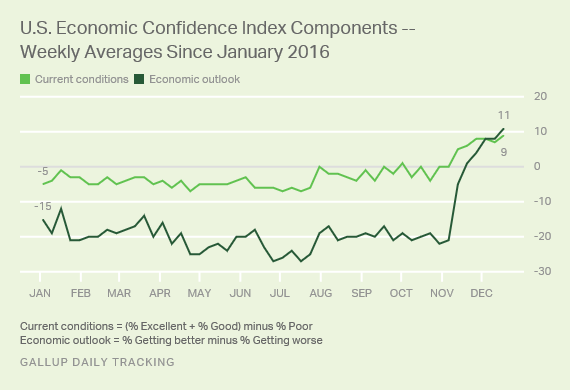
In 2009 President Obama inherited the worst economic conditions this country had seen since at least 1981, if not 1929. Investors had lost faith in financial markets. Uncertainty in goods and services markets locked up the labor market. And newly indebted home owners lost the means to consume.  There was no bottom in sight. Gallup recorded an economic confidence (ECI) score of -65 when Obama took office. And that number never got back to black until this month when it magically shot up 31 points after Trump's election.


Obviously we can speculate that Republicans are only now accepting Obama's economy as good because a Republican is about to take office. But then shouldn't we expect Democrats to shift the opposite way? In that "both siderist" scenario, the ECI should look fairly flat.  As any liberal blogger can tell you, both siderists don't deal in reality.

So what is the reality here? It's quite simple actually. Liberals view economic conditions the way they are supposed to look at them. If the economy is doing well they have a favorable view (even when a Republican is sitting on the Iron Throne). If the economy is doing poorly, they have an unfavorable view (even when a Democrat is in charge).  But it's pretty clear that Conservatives don't operate the same way.  With the economy collapsing in 2008, Conservatives were saying things like "the fundamentals of the economy are strong." They pointed to Bush's housing-led growth from 2003 to 2007 as "52 months of ... uninterrupted job creation, longest in the history of the country."

But as this chart from politicsthatwork.com shows,  that clearly was not the case:


Which brings me to my main question, who is to blame for this divide? As it turns out, in the 1990s, Republicans actually thought the Clinton economy was great... at least until 1998. In 1998 even as we were experiencing the best economic growth in the post-war period, a new channel was starting to become available on TV sets nationwide.  In 1996, 17 million households had access to Fox News. Over the next four years that number was up 440%.  And with that greater reach came the first steps toward the idiocracy.

Friday, December 9, 2016

Another Gaggle of Post-Mortems

It's been a busy week, both in my life and in the more immediate volley from the tennis ball machine that is the Trump Presidential transition (TM Bob Cesca). I've been accumulating more columns and data dissecting last month's tragedy. I'm hoping I can pull this many into something coherent. Well, here goes.

Since I just referenced Bob Cesca, let's start with his piece from Wednesday. He asserts that the Dems really didn't experience much of a loss, having won the popular vote by so much, and the loss of white working class voters is overblown:

The shift in white blue-collar voters from Obama in 2012 to Trump in 2016 is much more anecdotal than is being acknowledged among A-list pundits. It’s a fluke that largely reflects a narrow pocket of voters who hate Clinton due to an ongoing geyser of attacks, mostly unfair or based on nonexistent complaints, that has been erupting constantly for 25 years. This was more about a reaction in a small handful of battleground districts rather than a coast-to-coast existential crisis within the Democratic Party.

He believes the Democrats need to ignore the Beltway conventional wisdom that comes up about their party every election, win or lose, that they need to tack to the center. Rather, he feels, going left is the way to go, and he has statistics to back that up:

On health care, 86 percent of Americans with insurance policies purchased via the Affordable Care Act like their coverage. Furthermore, if we take the word “Obamacare” out of the equation, most Americans love the individual parts of the law.
Regarding taxes, 61 percent of voters surveyed think the wealthy aren’t paying their fair share in taxes and 67 percent believe corporations aren’t paying enough.
Concerning Wall Street, 58 percent of those surveyed support breaking up the big banks. Much of the credit here should go to Sen. Bernie Sanders, for setting an example of how Democrats can sell leftist issues without apology.
On income inequality, 66 percent of respondents agree that wealth should be more evenly distributed.
When it comes to college tuition, 62 percent of those polled want debt-free higher education.
Regarding abortion, most Americans surveyed believe abortion should remain legal in some if not all circumstances. Only 19 percent of voters think it should be illegal in all cases.

I'm with him on policy; not sure yet on the "WWC." (though I'm leaning that way, there are stats showing otherwise too)

Just one disagreement, and it's more a matter of degree because I think it's overblown:

The shift in Republican control over state legislatures, governorships and the U.S. Congress is less a consequence of the Democratic platform and more about the rise of conservative media, conservative propaganda and, yes, fake news.

Yes, conservative media and fake news are problems, but the bigger factor, as I've said in the past, appears to be how the mainstream media covers politics. I'm not going to link to anything I've written, because the inimitable Driftglass has written a tour de force (the danged thing, including citations, is about 5000 words) about it (SOMEBODY PAY THE MAN -- DAVID BROCK, I'M TALKING TO YOU). Take it away, Mr. Glass:

This is why I can tell you that this idea that "better messaging" to the white working class is somehow the royal road back to political majorities for the Democratic party is nonsense.  Sure, Democrats always need to work on speaking like mortal human beings and progressives in general suffer from an inexplicable inability to kill the fucking bunny even with all the claws and fangs at their disposal:
But messaging itself is not the problem.  The media is the problem.  And since, as the man said, the medium is the message, until we start taking on the media as Public Enemy #1, we're going to go right on losing.
This is shaping up to be a long post because sometimes I feel the need to drive a point home using a great big hammer, so if you want to scroll on down, be my guest.  But before you move along, my premise is fairly easy to summarize:
For a variety if reasons, white working class Americans have been taking a pounding since the late 1970s.  And for a different variety of reasons, a disturbingly high number number of white working class Americans keep voting for the people that fuck them over.
Judging by policy statements made, resources allocated, attention paid and political capitol spent, it's quite likely that history will judge the Obama Administration to have been the most consistently pro-manufacturing administration since Eisenhower.  In fact, outside of health care (and turkey pardons), I would wager a penny and a fiddle of gold that in the last eight years the Obama administration put more effort into promoting American manufacturing than into any other domestic policy priority.
If you are a member of the general public, unless you made an extra special effort to inform yourself, you are blissfully unaware of any of this.
If you are blissfully unaware of any of this, it is not because the Obama Administration failed to talk it up at every single opportunity, but because over the last eight years the American political media collectively decided that instead of boring-ass stories about what the Democratic party has been trying to do to improve the lives and futures of the working class Americans, what you needed to hear were lively fairy tales about Birth Certificates and Death Panels.  Email servers and Benghaaaazi.  A Republican rebranding scam called the "Tea Party".  Instead of stories about the Caucus Room Conspiracy and Republican sabotage and sedition, you needed to hear endlessly, plaintive cries from all the usual Beltway hacks about how Barack Obama was refusing to lead!
So, as the late, great Al Smith used to say, let's take a look at the record...
I have spent a couple of days going over hundreds of White House press releases, public statements, sections of each of President Obama's State of the Union addresses, etc. all on the subject of American manufacturing.  This is a small, representative sample from that gargantuan pile, with emphasis added by me as the spirit moves me.  
And he presents exactly that. Bottom line, the Obama administration presided over the creation of 800,000 new manufacturing jobs since the end of the Bush recession (note that that's about the likely exaggerated number that Bernie Sanders said NAFTA cost the sector, so at worst the Democrats caused a net gain over time, and that's if you even consider NAFTA a Democratic deal) , but nobody noticed because the media rarely talked about it.

Anyway, read the whole thing, but I want to bring in a little more detail from a couple of the articles Driftglass cites.

Tons of useful stuff (of course), from Rick Perlstein. The meat for me, for the purpose of my post-morteming:

Trump boogied his way to Pennsylvania Avenue to the tune of the extraordinary finding by a Washington Post-ABC News poll that “corruption in government” was listed by 17 percent of voters as the most important issue in the presidential election, second only to the economy, and ahead of terrorism and health care—and that voters trusted Trump over Clinton to be better on the issue by a margin of 48 to 39 percent, her worst deficit on any issue. This is the part of my article where rhetorical conventions demand I provide a thumbnail sketch of all the reasons why it’s factually absurd that anyone would believe that Donald Trump is less corrupt than Hillary Clinton. I have better things to do with my time than belabor the obvious.
Yet somehow, the great mass of Americans believed Clinton was the crook. Might it have something to do with the myriad articles like, say, “Smoke Surrounds the Clinton Foundation,” by The Los Angeles Times’s top pundit Doyle McManus? This piece, all too typically, despite endeavoring to debunk Trump claims of Clinton corruption, repeated charges like “Doug Band, who helped create the Clinton Global Initiative, sought access to State Department officials for Clinton Foundation donors”—even though donors did not get that access). And that donors harbored the “assumption” that they would “move to the head of the line”—even though they never did.
Trump gave absolutely no indication that he was anything but corrupt since the first time he ever seriously considered running for President back in 2000. And it's not even worth linking to how corrupt he's turning out to be as President-Elect because it would take me from now until Inauguration Day just to cover the first week post-election.
And what were pundits like McManus smoking? The vapors from a cunning long-term disinformation campaign run by the man Donald Trump appointed as his chief White House political strategist. Steve Bannon chartered a nonprofit “Government Accountability Institute,” whose president, Peter Schweizer, hacked out an insinuation-laden tome, Clinton Cash: The Untold Story of How and Why Foreign Governments and Businesses Helped Make Bill and Hillary Rich, then offered its “findings” on an exclusive pre-publication basis to the Times, which shamefully accepted the deal—with, predictably, the public’s perceptions of Clinton’s trustworthiness cratering in tandem with our national Newspaper of Record’s serial laundering of Steve Bannon’s filth.
So where did it come from? A book published by STEVE BANNON that the New York Times took as gospel for just long enough to not be able to put that cat back in the bag. This is why I tend to fact-check the Times nearly as much as I do PolitiUncutCo or whatever these days. The New York Times has been at the wide end of the anti-Clinton puke funnel since the Whitewater days. Fuck 'em. I'm never subscribing.

Derek Thompson at the Atlantic makes a point I tried to make a couple of weeks back -- Hillary did have a message for the working class (white or not):

But here is the troubling reality for civically minded liberals looking to justify their preferred strategies: Hillary Clinton talked about the working class, middle class jobs, and the dignity of work constantly. And she still lost.
She detailed plans to help coal miners and steel workers. She had decades of ideas to help parents, particularly working moms, and their children. She had plans to help young men who were getting out of prison and old men who were getting into new careers. She talked about the dignity of manufacturing jobs, the promise of clean-energy jobs, and the Obama administration’s record of creating private-sector jobs for a record-breaking number of consecutive months. She said the word “job” more in the Democratic National Convention speech than Trump did in the RNC acceptance speech; she mentioned the word  “jobs” more during the first presidential debate than Trump did. She offered the most comprehensively progressive economic platform of any presidential candidate in history—one specifically tailored to an economy powered by an educated workforce.
What’s more, the evidence that Clinton lost because of the nation’s economic disenchantment is extremely mixed. Some economists found that Trump won in counties affected by trade with China. But among the 52 percent of voters who said economics was the most important issue in the election, Clinton beat Trump by double digits. In the vast majority of swing states, voters said they preferred Clinton on the economy. If the 2016 election had come down to economics exclusively, the working class—which, by any reasonable definition, includes the black, Hispanic, and Asian working classes, too—would have elected Hillary Clinton president.
The more frightening possibility for liberals is that Clinton didn’t lose because the white working class failed to hear her message, but precisely because they did hear it.
That message either wasn't heard, or Trump's message of fear, xenophobia, and hate resonated more with whites because they care about keeping others down than improving or even maintaining their own lot in life (which is basically the definition of a conservative).

After everything I've read over the last month, I'm inclined to agree with that last sentence. But Konstantin Kilibarda and Daria Roithmayr at Slate do not (go figure; contrarianism for contrarianism's sake is essentially what Slate is about). But I'm willing to hear them out without much commentary from me. These are their five main points supporting their thesis about how Hillary lost the Rust Belt rather than Trump winning it:

1. In the Rust Belt 5, the GOP’s pickup of voters making $50,000 or less is overshadowed by the Democrats’ dramatic loss of voters in that category.

2. Republicans in the Rust Belt 5 picked up almost as many wealthy voters making over $100,000 as voters who made less than $50,000.

3. Trump did not flip white voters in the Rust Belt who had supported Obama. Democrats lost them.

4. The real story—the one the pundits missed—is that voters who fled the Democrats in the Rust Belt 5 were twice as likely either to vote for a third party or to stay at home than to embrace Trump.

The work of Martin Longman, whom I've cited a lot on this, plus the fact that Trump appears to have hit the high water mark for Republicans (more on that another time) in terms of total votes while Hillary appears to be approaching the second-highest mark in the popular vote for any candidate, ever. But I'll be digging into their work more because their viewpoint is as valid as any, until it's not.

Ari was just saying to me that in the last week, undecided broke for Trump, and he and many others believe that's due to the Comey letter. Kevin Drum's got a post up about the generally negative coverage of the campaign, but this is the part that stands out to me:


I can see how the Comey letter would dip Clinton's numbers at the end, but why did the media (relatively) fawn all over Trump over the last three weeks? Did they shine a positive light on his sexual assault stories? I honestly don't remember; once I started working heavily with the campaign in October, I mostly only had time to keep my eye on the polls more than the stories.

What post-morteming since 1992 would be complete without talking about conservative evangelical Christians? Digby shares a Washington Post article that tells us that conservative evangelicals sided with Trump because of some Supreme Court decision from last year:

The presidential election was so close that many factors were “but-for” causes of Donald Trump’s victory. One that’s been mostly overlooked is Trump’s surprising success with religious voters. According to exit polls, Trump received 81 percent of the white evangelical Christian vote, and Hillary Clinton only 16 percent. Trump did significantly better than the overtly religious Mitt Romney and the overtly evangelical George W. Bush. He likely over-performed among other theologically conservative voters, such as traditionalist Catholics, as well. Not bad for a thrice-married adulterer of no discernible faith.
To what can we attribute Trump’s success? The most logical answer is that religious traditionalists felt that their religious liberty was under assault from liberals, and they therefore had to hold their noses and vote for Trump.
The DID NOT "hold their noses and vote for Trump." They enthusiastically voted for Trump. They had 16 other god-bothering candidates they could've voted for in the primary, yet they voted for him. Why? For the same reason the "white working class" did. Fear, hate, and xenophobia. These are the same people who tried to hold on to segregation as stridently and longer than just about anyone else. Trump gave them a much more luscious taste of that cracker-white apple than Bush, McCain, or Romney did. As we Jewish people say, "Zehu!"

Washington Post, you should know better already.

From the Washington Post to the Washington Monthly:

We’ve heard for months now that Donald Trump is as much a threat to the Republican Party as to the Democrats – and that part of his appeal was being tough on both of the stale/corrupt two parties.
Sure enough, there is evidence that on November 8, voters simultaneously said they liked Trump but disliked Republicans. Because the Democrats fell short of both expectations and winning power, it was barely noticed that:
40% of voters viewed Republicans favorably compared to 47% for the Democrats.
The triumphant, newly-re-elected Republican Congress has a 15% approval rating.
Republicans did lose two Senate seats and six House seats – a horrible disappointment for Democrats but still, you know, an actual loss of seats.
More people voted for Democrats in the Senate races than for Republican.
And yet the Republican Party has more power now than it has in decades, and is acting as if the party received a tidal-wave mandate.
Why? Because they cheat.

Aaaaand finally, I have to *#%@ing celebrate the return of the Rude Pundit, who comes back just in time to make the cut on this post. And he needed no stretching, or shootaround, or practice swings... he's on fire:

When I first put myself in a self-imposed time out, one of the reasons was that I was really fucking pissed at myself for getting the presidential election so wrong, for thinking that it was a no-brainer that Hillary Clinton would be elected, that the country wasn't so stupid and deluded and hateful that it would elect a fuzzy, bulbous fungus in human form instead.
.
.
.
But lately, I've come around to another way of thinking. I wasn't wrong. Our election system is so innately fucked that it got it wrong. Right now, Clinton is up by nearly 3 million votes. That's 2 percent more than Donald Trump, with a lead that's growing with every precinct finalized. Yeah, yeah, she didn't win the presidency. But I wasn't wrong about the country. Nearly 54% of voters rejected Trump. And a plurality supported Clinton by far.  
.
.
.
Trump won because the Founders created a fucked-up system to make slave states feel wanted because conservatives have always thrown a fit if you don't just accept their ignorance. We can delude ourselves and say that "in their wisdom" the Founders created the Electoral College as a way to put the brakes on the election of a vile blithering idiot with dictatorial aspirations. But it's that very system that has gotten us to this point.
And the kicker, which is an actual, honest-to-FSM ACTION that addresses the desperate pleas I've made the last two days, which agreeing with me about the reason said action just ain't gonna happen:

(If Clinton truly wanted to fight, she'd take Lawrence Lessig's advice and go after the constitutionality of the apportionment of the electors. Republicans would do it in a heartbeat if the electoral and popular vote were reversed. But Democrats never fight like that. The GOP is throwing sand in our eyes and stomping us while we're wondering why the ref doesn't call a penalty.) 

Fuck yes, Mr. Papa. Welcome back to the good fight.

Sunday, November 27, 2016

Noting for Further Exploration

Just last week, I said on Facebook: "I'm three episodes behind on The Walking Dead, and I'm not sure if I'm going to catch up because it's hitting too close to home..."

There may be something to that:

Deep Root Analytics, a media consulting company founded in 2013, moves beyond traditional “spray and play” advertising operations in order to maximize their clients’ television commercial campaigns. So when Forbes writer Steven Bertoni explains Kushner and the Trump campaign’s use of the company’s services as “identifying shows popular with specific voter blocks in specific regions,” he isn’t mincing his words. These tools literally let them identify what programs potential voters were watching, targeted them via those shows, and amplified any and all successful efforts.
Hence why The Walking Dead fans saw so many pro-Trump ads during their favorite show’s commercial breaks — especially ads pertaining to the Republican nominee’s stance on immigration. After all, it’s a series about a dystopian future in which the protagonists must fight against a constant barrage of outsiders, both dead and alive. Rick Grimes and company aren’t too fond of newcomers, be they old allies from seasons past or violent antagonists equipped with barbed wire-encrusted baseball bats.
On Daily Kos today, Ian Reifowitz wrote about how the election came down to race, not the economy:
Given that Trump began his campaign with racist rhetoric and never really stopped, it also makes quite a bit of sense on the surface. There’s one problem: The numbers say it doesn’t hold water.
.
.
.
From the national exit polls, here are the numbers that disprove the whitelash thesis: Trump did a slim 1 percent better among whites than Mitt Romney did four years ago. Were some whites drawn to Trump’s side by racism? Absolutely. But he appears to have lost pretty much an equal amount among those whites disgusted by it.
Furthermore, Trump improved over Romney by much more among every non-white ethno-racial group large enough to measure. He improved by 7% among blacks, 8% among Latinos, and 11% among Asian voters. Along similar lines, an exit poll conducted by the Council on American-Islamic Relations (CAIR) found that Trump received 13% of the Muslim vote. That doesn't sound like much, but it represents almost twice the percentage Romney won. No whitelash there.
Overall, turnout looks like it will come in at just about the same percentage of the eligible voter population as we saw in 2012. However, as Northern Ohio University political science professor Robert Alexander explained, “You saw turnout spike in more rural counties. If you take a look at a lot of the larger cities you did see depressed turnout there. It certainly was more consequential for Hillary Clinton than it was for Trump.”
Despite the more heavily rural voting population compared to 2012, Trump didn’t do significantly better than did Romney among whites overall. Of course, given that whites are about two-thirds of the voting population, gaining 1 percent among whites is important, but the gain of about 8 percent overall in the one-third of the voter population that is not white adds up to more votes. 
On the same day, Andrew Prokop at Vox asserts essentially the opposite; the election did not hinge on the economy, or at least not as far as the Senate goes:

Interestingly enough, in two of those crucial Midwestern states that flipped to Trump, Democratic Senate candidates campaigned on economically populist platforms — but they did notably worse than Hillary Clinton. Russ Feingold underperformed Clinton by 2.4 points in Wisconsin, and Ted Strickland underperformed her by 12.8 points in Ohio. Feingold amassed a populist record of challenging big money and special interests when he was in the Senate, and Strickland harshly condemned trade deals during his campaign against Rob Portman (who served as George W. Bush’s US trade representative).
Meanwhile, the two Democratic Senate candidates in competitive races who outperformed Clinton the most both self-consciously presented a moderate image rather than running as liberal firebrands. In Missouri, Jason Kander overperformed Clinton by 15.9 points, and in Indiana, Evan Bayh did 9.6 points better than her (though they both lost).
I'm still figuring that out myself; I'm going to save this post to review in a couple of weeks after all of the ballots have been counted and matched up against the exit polls.

UPDATE (11/28/16, 1:18 AM): Digby has something to say on the topic, as well.

Tuesday, November 22, 2016

Pedaling that Unification Bicycle

Because there's always someone who can say things better than I can, Echidne makes the point about the Democrats not needing to drop anti-racism to increase support from the rural areas in the Midwest:

I'm going to take a guess on economic progress in that context, on trying to revive the ghost towns of the Rust Belt, on trying to stop the ravages that outsourcing and globalization have wrought there and on trying to make the Democratic Party refocus on combating income inequality and other similar economic topics.

But doing so doesn't mean that the party should drop human rights and civil rights concerns.  It should be able to chew gum and pedal that unification bicycle at the same time.  The political games inside the Party do not have to be zero-sum games.
The question will remain, what's the right balance of chewing and pedaling? It's going to take some time to figure that out.

Monday, November 21, 2016

Rope-A-Dope on Obamacare?

More from TPM on "Repeal and Replace":

McCaskill challenged Trump and Republicans "to be honest" and actually come up with a plan rather than just ragging on Obamacare.
"Let's see how that would work for the millions of people who have certainty and security right now," she said.

Democrats admit that Obamacare needs some fixing, but they are dubious Republicans can just do it themselves.

"I think they should fix Obamacare and call it a repeal and replace," said Sen. Brian Schatz (D-HI).

"That is both the best public policy and the best politics for them. If they actually repeal the thing, people are going to suffer and they will suffer electorally."

Republicans are balancing conflicting pressures. On the one hand, they have promised their constituents for nearly seven years that they would repeal and replace this law. They have little wiggle room to escape that now. They've gone through the motions to pass legislation repealing it dozens of times, but the president's veto was a stop gap.
I don't know if this is the best strategy, but is another one available to the Democrats? The problem here is, it depends on both shame and the fear of the response from voters. The Republicans have no shame, and enough may be in really safe seats or be backstopped by the prospect of cushy think tank or lobbyist jobs if they succeed in gutting Obamacare or do lose. The potential gain for Republican backers if they get Obamacare repealed is likely massive in comparison to having to promise a "safety net" to Republicans taking the leap on their behalf.

In other news:

Republicans, according to Politico, plan to roll back DAPA, an Obama administration order that gave the parents of DREAMers legal status to stay in the U.S. without fear of deportation. Republicans also want to reverse Obama's fiduciary rule, which was designed to eliminate conflicts of interests for financial advisers who were balancing corporate clients and individual investors. The other rule Republicans want to eliminate is an overtime rule that requires companies pay overtime to employees making $47,000 or less a year, Politico reported.

Republicans are also prioritizing tax cuts, according to the Politico piece. While they will use the procedural process known as budget reconciliation to repeal and replace Obamacare as soon as January, they are also considering using another budget reconciliation process for the 2018 budget to push through tax cuts.
Obviously, Republicans want to screw immigrants. But look at the other items they're trying to get through. Overtime? Easing rules on banks? Tax cuts on the wealthy? This should be obvious to anyone who has been paying attention at all, but for the media to keep saying the it's the DEMOCRATS who can't appeal to the working class?

Yesterday, I published quite the stemwinder disagreeing with Ed at Gin and Tacos. Today, I agree 100% with this:

Given that reality, the Democrats' failure was in not offering a scapegoat. Maybe it's time to dust off the Joe Hill / Mother Jones / Eugene Debs playbook. If scapegoating is the only thing that wins these people over, then the best strategy is to point them in the right direction again and remind them that Capital is the enemy of Labor. End the worship of and fixation with Job Creators and the idea that the boss is your buddy and your role in the economy is a matter of personal responsibility, fully within one's own control.

Is that going to work? Doubtful. Racism is an easier, more effective play. Anything that requires people to think is going to lose out to anything that plays directly into their basest prejudices. I don't know how you beat the path of least resistance. The older I get, the less I believe that is possible.
It's not that the Democrats don't have a message that can appeal to the "white working class." It's that their message is inherently not as strong as racism, and if the Democrats want their votes, they need to push their economic message at least twice as hard as the Republicans push their racist one, which slides down as smoothly as butter.

UPDATE: Adam Johnson at FAIR has more on "identity politics" and appealing to the "white working class voter."

Saturday, November 19, 2016

Exploring the minimum wage

With the basic economic theory of supply and demand, anyone can look at the price of a good or commodity and see that less of it will be demanded as the price rises. That eventually causes an oversupply so prices will have to fall. Think about what will happen when Nintendo finally increases the supply of NES Classics (but probably long after the holiday craze has worn off).  As of this post, the price on Amazon is $225, but the MSRP is just $60. As supply picks up and meets demand, prices will eventually adjust back to $60.

Taking it a step further, we can add a price control that artificially keeps prices high (or low). Think about farm subsidies (or rent control).  That basic economic theory states that if the market isn't able to clear because of some outside interference, then the market will be inefficient and is therefore unquestioningly a bad thing.

So what does economic theory say about the minimum wage? Following the basic theory, we can consider a minimum wage to be a price control that artificially sets wages above equilibrium. That means there will be fewer "buyers" of labor. So many point to that and say it clearly leads to job losses.

But how does that actually stack up in reality? We've raised the minimum wage dozens of times over the last century and there has not been a single time in which an increase in the Federal Minimum Wage has led to job losses. But this isn't anything new.  Back in the 1990s, two economists began working on a study that compared different minimum wages across state lines. What Card and Krueger (AER, 1994) found was that an increase in the NJ minimum wage had no significantly different shifts in employment relative to next-door PA which operated at the Federal minimum.

OK so what gives? As it turns out, minimum wage jobs are not desirable (imagine that!). Without getting into the more complicated monopsonistic economic theory, let's think about what would happen if there was a town that had only one employer. And if it was a pretty lousy employer offering a very low wage so nobody really wanted to work for them.  Some people would have to do it because they really needed the money. But many would decide it wasn't worth it and instead would start their own business or chose to make money Ubering or reselling NES Classics on eBay. If the wage increased, some of those people might now decide it would be worth while to actually apply for the job. That would be an increase in labor supply.  The people coming into the market now would be slightly better off (and more skilled) than those that were already in the market initially. And so with that increase in wage, the average level of productivity would begin to rise.  That means the company would actually end up doing a little better and, in turn, begin to hire more workers.

The lesson here is that the economy is not static -- it's always changing. And if the government can enact policy that increases worker productivity, that's almost always a good thing for economic growth. Let's hope we end up with some real economists advising the President on fiscal policy and not Meatloaf.